I've got a very similar setup on my lathe, and while that's not a milling machine, the setup has a lot in common.
I have a Chinese glass encoder on the Z axis and a magnetic encoder buried in the X axis (under the cross slide). The Z axis has an inductive (technically eddy current) proximity switch for homing and the X axis has a microswitch.
Those both work in closed loop. I don't use backlash compensation but the axes used NOS, Japanese ground ballscrews.
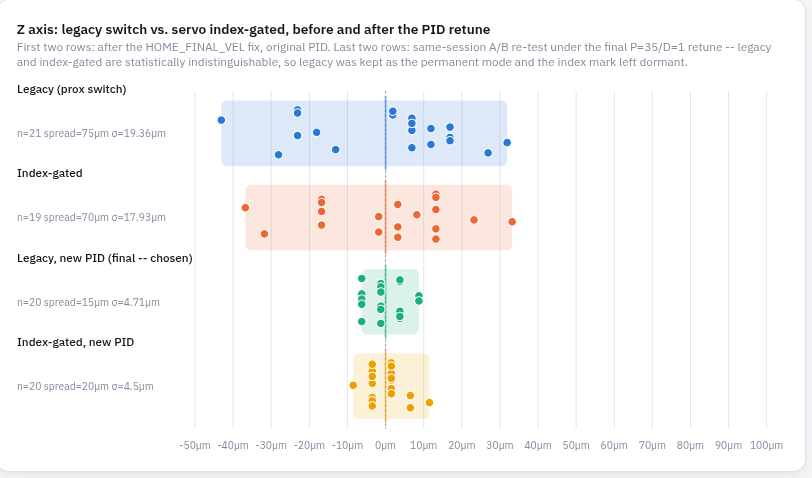
I spent several hours recently implementing "index mark" homing on both axes, using the synthesised encoder outputs from the servo drives and perhaps surprisingly there was no obvious benefit, so in the end I simply reverted to using the limit switches.
This is partly due to the way the index pulses are read by the 7i85, but then subsequently processed by Linuxcnc. I also suspect that some of the remaining variation is in the mechanism between the servo motors and the actual axis ie toothed belt, ballscrew, bearings, mechanical slop etc.
When you look at it that way, it doesn't seem obvious that moving the servo motor to a particular angular position after homing to the switch would necessarily deliver any obvious benefit. Either way, repeated testing with a decent DTI showed clearly that while the system was working, it didn't improve the homing repeatability or accuracy in my case.
This outcome may differ with your machine. Mine can only resolve / achieve 5um repeatability due to the encoder resolution and although I have good ballscrews and the machine is well adjusted, it wasn't built as a CNC machine, so is perhaps not the optimal choice.