

- Posts: 19
- Thank you received: 2
Lathe C axis homing
6 months 2 weeks ago #345546
by jetbadger
Replied by jetbadger on topic Lathe C axis homing
I was thinking that 1:1.45 overdrive of the spindle could be an issue, but it just doesn't make sense that it would also misbehave without encoder feedback, when it's just an open loop system.
The motor is rated 5.5kW. It's on the slower side but the torque should be plenty I'd think. I've spent the last night rolling around thinking of this and I'm pretty sure it must be something to do with step scaling, accel values or something like that. Maybe there is too many steps? 10k per revolution and it's causing issues for unknown (to me) reason. I will try to test that next and see if that makes any difference.
The motor is rated 5.5kW. It's on the slower side but the torque should be plenty I'd think. I've spent the last night rolling around thinking of this and I'm pretty sure it must be something to do with step scaling, accel values or something like that. Maybe there is too many steps? 10k per revolution and it's causing issues for unknown (to me) reason. I will try to test that next and see if that makes any difference.
Please Log in or Create an account to join the conversation.

6 months 2 weeks ago #345554
by PCW
Replied by PCW on topic Lathe C axis homing
Can you plot (with halscope) the C axis commanded and feedback positions?
That would help diagnose the issue.
That would help diagnose the issue.
The following user(s) said Thank You: spumco
Please Log in or Create an account to join the conversation.
6 months 2 weeks ago #345557
by jetbadger
Replied by jetbadger on topic Lathe C axis homing
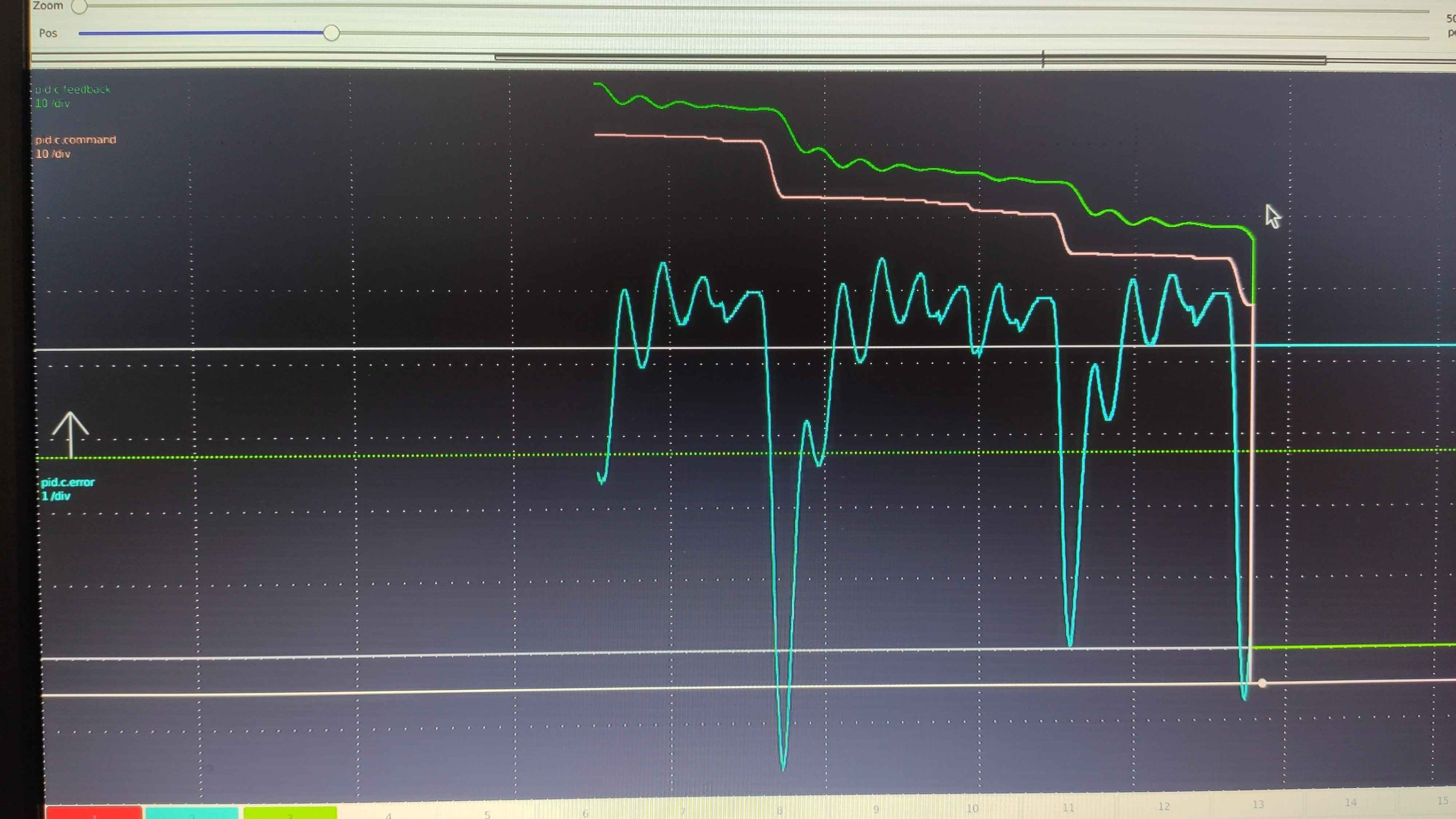
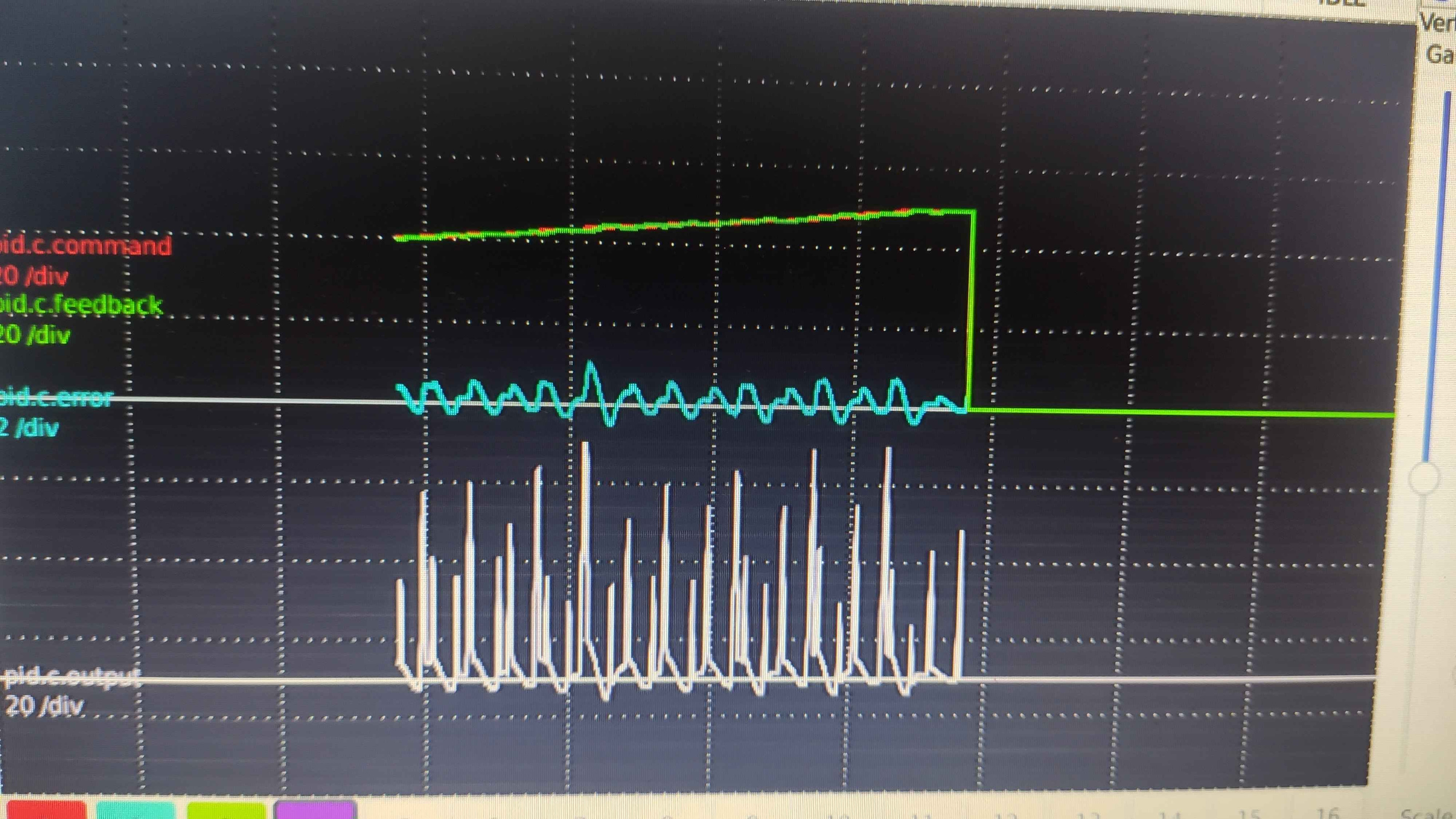
I have these snippets right now. The first is the original behaviour and the next one is after a full day of tweaking the PID values and acceleration. In both the axis moves very slowly.
Please Log in or Create an account to join the conversation.
6 months 2 weeks ago #345562
by PCW
Replied by PCW on topic Lathe C axis homing
I guess my question now would be: Why are there relatively huge steps in the commanded position?
Please Log in or Create an account to join the conversation.

6 months 2 weeks ago #345564
by spumco
Replied by spumco on topic Lathe C axis homing
The drive is at 10000 PPR and around 1.45:1 spindle:motor overdrive, from my calculations 6k rpm spindle speed is around the limit.
I finally checked your drive manual. Your drive can handle 4mhz pulse input when using differential signals.
If your drive is set to the default input of 10,000ppr (parameter P0.22), and you want ~4100rpm (motor) for 6000rpm (spindle), that means your maximum pulse frequency will be ~680khz.
Tuning or inertia issues aside, it also results in a fairly coarse positioning resolution of 19 pulses per degree.
You could increase the drive positioning resolution by a factor of 4 without running in to the drive's (or Mesa's) input frequency limit.
However...unless I'm looking at the wrong manual - or you have an unlisted motor - the 5.5kw servo is advertised as having a max speed of 2000rpm.
Do you have a different motor/drive than is listed in the manual? If not, I'm not sure that motor is going to do what you want in spindle mode.
I finally checked your drive manual. Your drive can handle 4mhz pulse input when using differential signals.
If your drive is set to the default input of 10,000ppr (parameter P0.22), and you want ~4100rpm (motor) for 6000rpm (spindle), that means your maximum pulse frequency will be ~680khz.
Tuning or inertia issues aside, it also results in a fairly coarse positioning resolution of 19 pulses per degree.
You could increase the drive positioning resolution by a factor of 4 without running in to the drive's (or Mesa's) input frequency limit.
However...unless I'm looking at the wrong manual - or you have an unlisted motor - the 5.5kw servo is advertised as having a max speed of 2000rpm.
Do you have a different motor/drive than is listed in the manual? If not, I'm not sure that motor is going to do what you want in spindle mode.
The following user(s) said Thank You: tommylight
Please Log in or Create an account to join the conversation.
6 months 2 weeks ago #345569
by jetbadger

Replied by jetbadger on topic Lathe C axis homing
That's exactly the issue I can't get rid of. This is just with G0Cxx commands. I'm suspecting if I zoomed in the second plot enough it would look the same just at higher frequency. For example when homing it acts fine but that's probably because the commanded position is instantly much different and the PID loop takes care of reaching it. But here the commanded position supposed to trail ahead by some degree to let the PID do it's thing I suppose and it just doesn't seem to work with the joint either reaching the position and output going to 0 and then falling behind and shooting up, rinse and repeat... If I lower the P ratio to where it trails just behind, the commanded position slows down aswell eventually leading to coarse steps like before.I guess my question now would be: Why are there relatively huge steps in the commanded position?
I'm aware that the motor is not exactly right for this, however it was already on there before me. It's the same one from the manual with 1500rpm rated speed, making for a pretty slow spindle. The 4MHz value is what I had in mind when figuring out the pulse widths and so on, I admit though I forgot about the motor rating, but for now in spindle mode I only had it in the hundreds range and in axis mode it's even slower. I will try increasing the resolution and see, thanks.I finally checked your drive manual. Your drive can handle 4mhz pulse input when using differential signals.
If your drive is set to the default input of 10,000ppr (parameter P0.22), and you want ~4100rpm (motor) for 6000rpm (spindle), that means your maximum pulse frequency will be ~680khz.
Tuning or inertia issues aside, it also results in a fairly coarse positioning resolution of 19 pulses per degree.
You could increase the drive positioning resolution by a factor of 4 without running in to the drive's (or Mesa's) input frequency limit.
Please Log in or Create an account to join the conversation.
Time to create page: 0.157 seconds