
LCNC-Cyclo: Conversational Programming for LinuxCNC
- Sviper
- Offline
- Senior Member
-

Less
More
- Posts: 79
- Thank you received: 13
15 Nov 2026 00:41 - 15 Nov 2026 00:44 #350701
by Sviper

LCNC-Cyclo: Conversational Programming for LinuxCNC
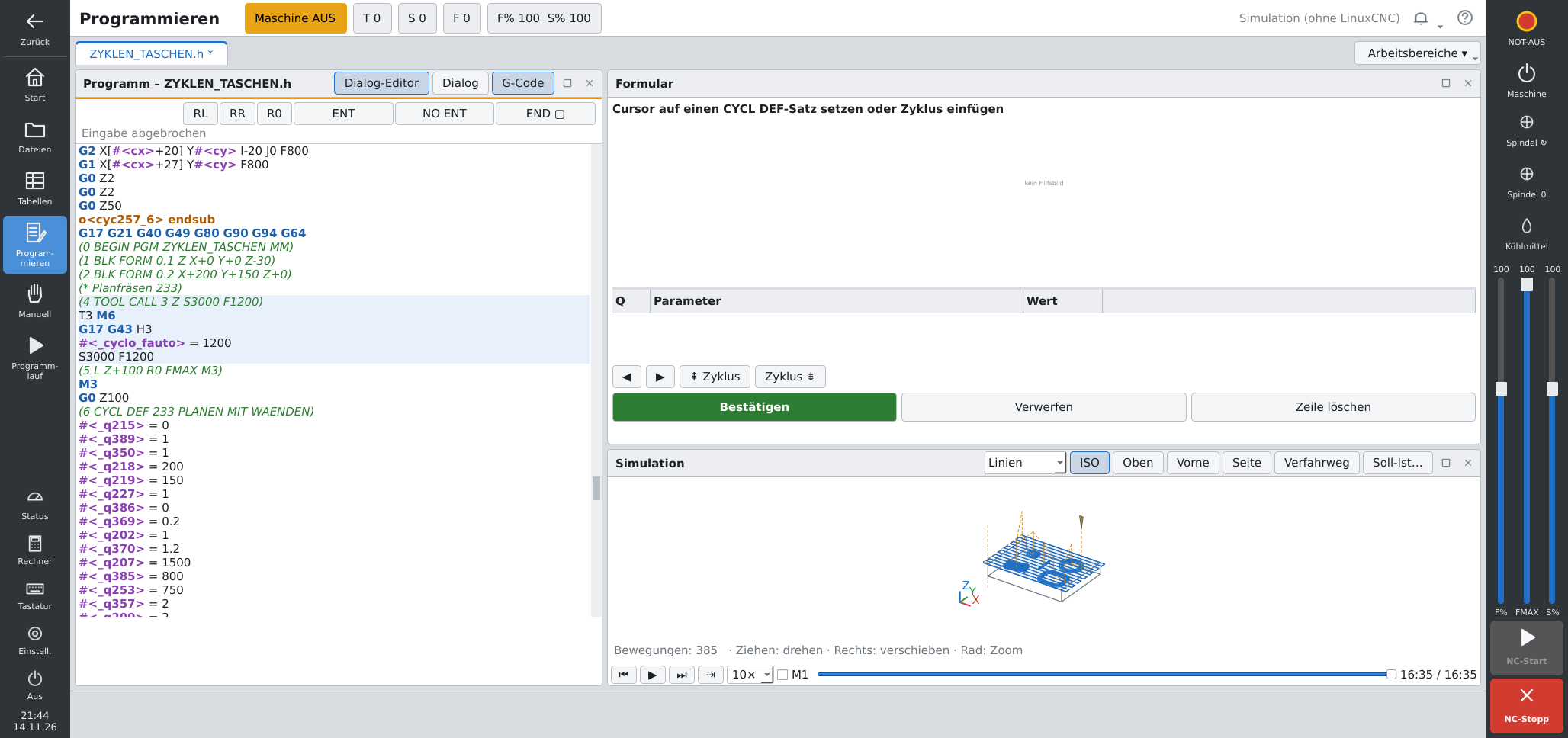
I'm currently working on LCNC-Cyclo, a shop-floor-oriented user interface for LinuxCNC. The idea: anyone who works with conversational-programming controls at their job should be able to work the same way on their own LinuxCNC mill at home. You write the program in conversational format, call a cycle, fill in the parameters in a form, and you're done.What already works:
LCNC-Cyclo: Conversational Programming for LinuxCNC was created by Sviper
LCNC-Cyclo: Conversational Programming for LinuxCNC
I'm currently working on LCNC-Cyclo, a shop-floor-oriented user interface for LinuxCNC. The idea: anyone who works with conversational-programming controls at their job should be able to work the same way on their own LinuxCNC mill at home. You write the program in conversational format, call a cycle, fill in the parameters in a form, and you're done.What already works:
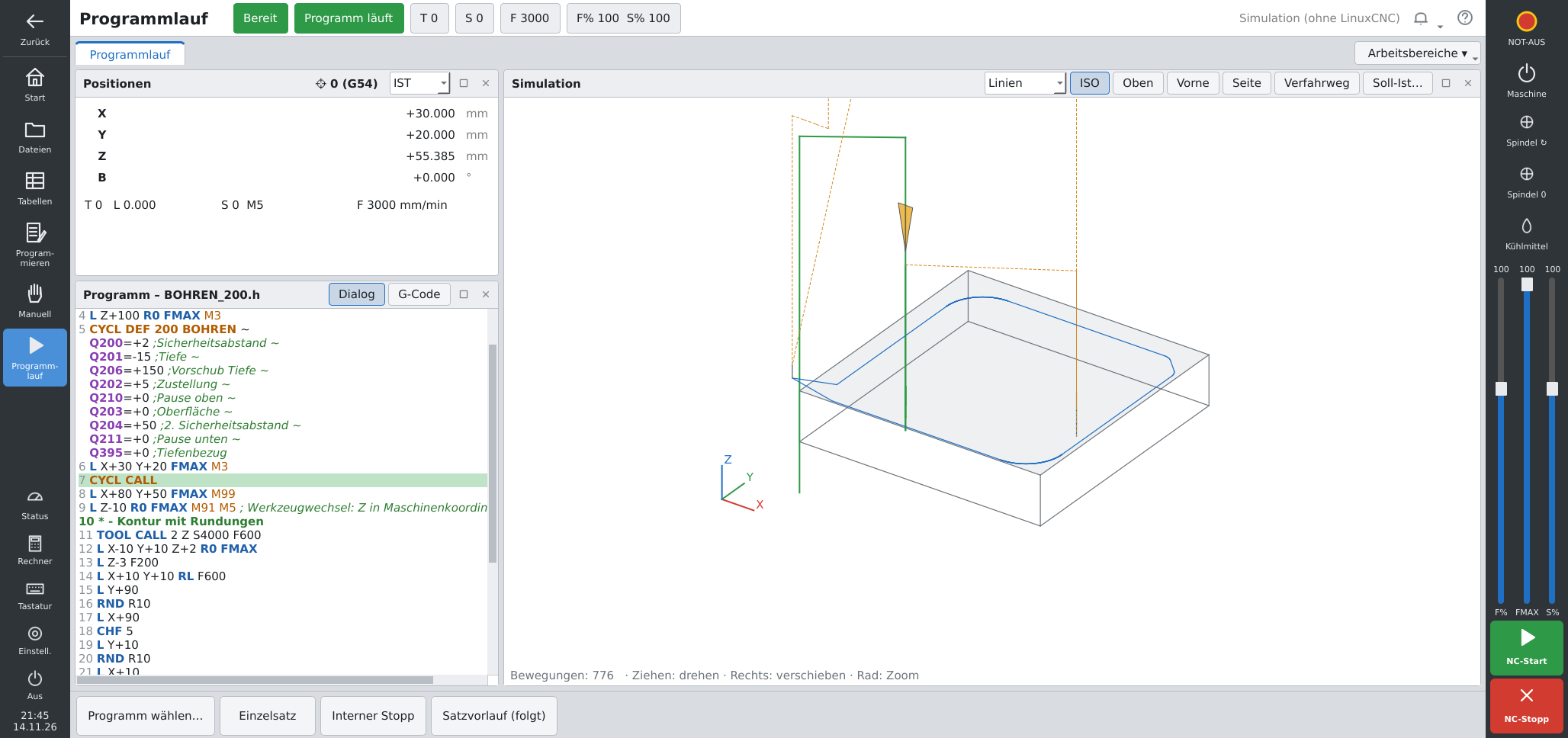
- All screen areas and operating modes you'd expect from a shop-floor control, light/dark theme
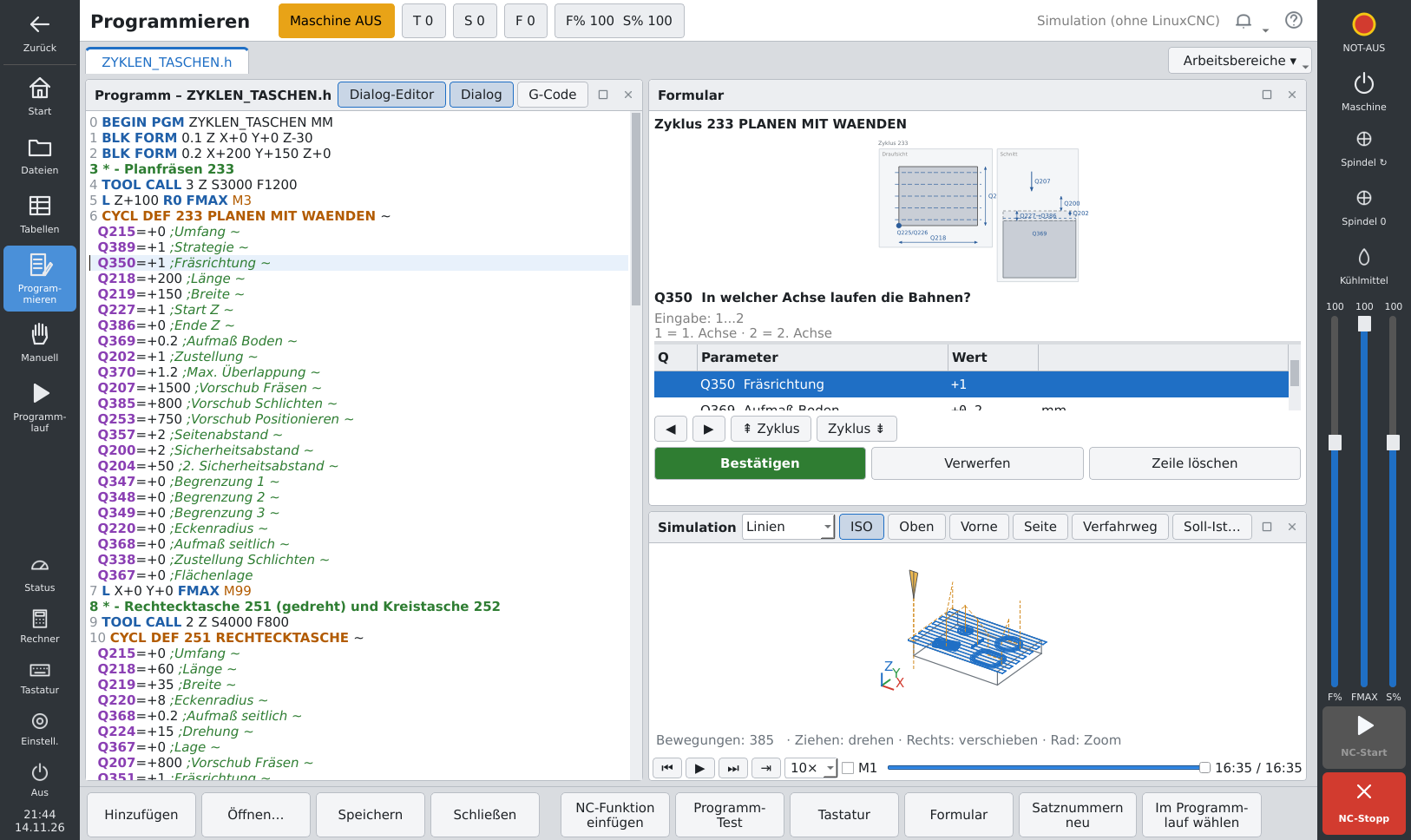
- 58 cycles: drilling, threading, pockets, SL/contour pockets, engraving … each with an input form and help graphic
- Conversational code is translated live into real LinuxCNC G-code, with a switchable view
- PLANE functions using LinuxCNC's tilted work plane (G68.2)
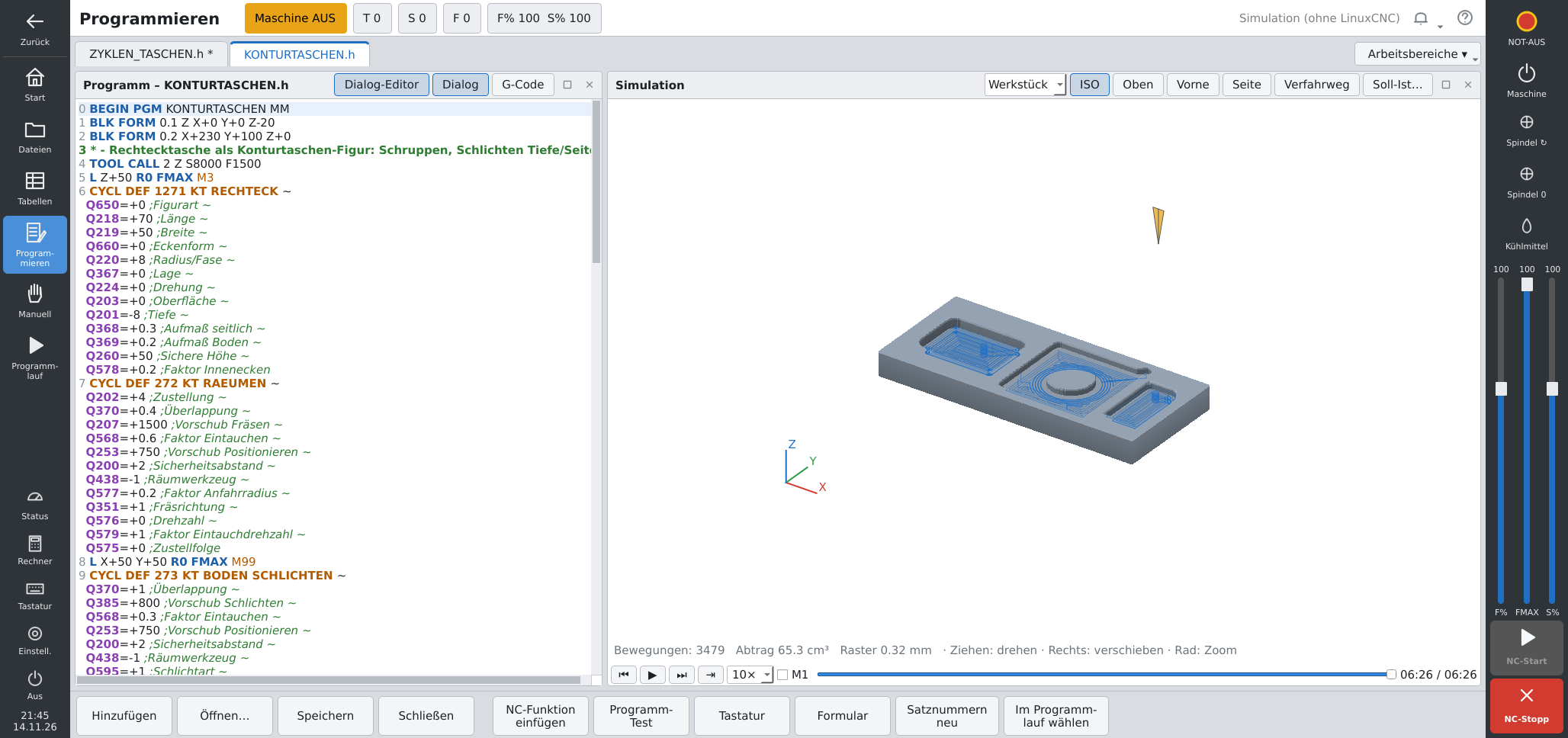
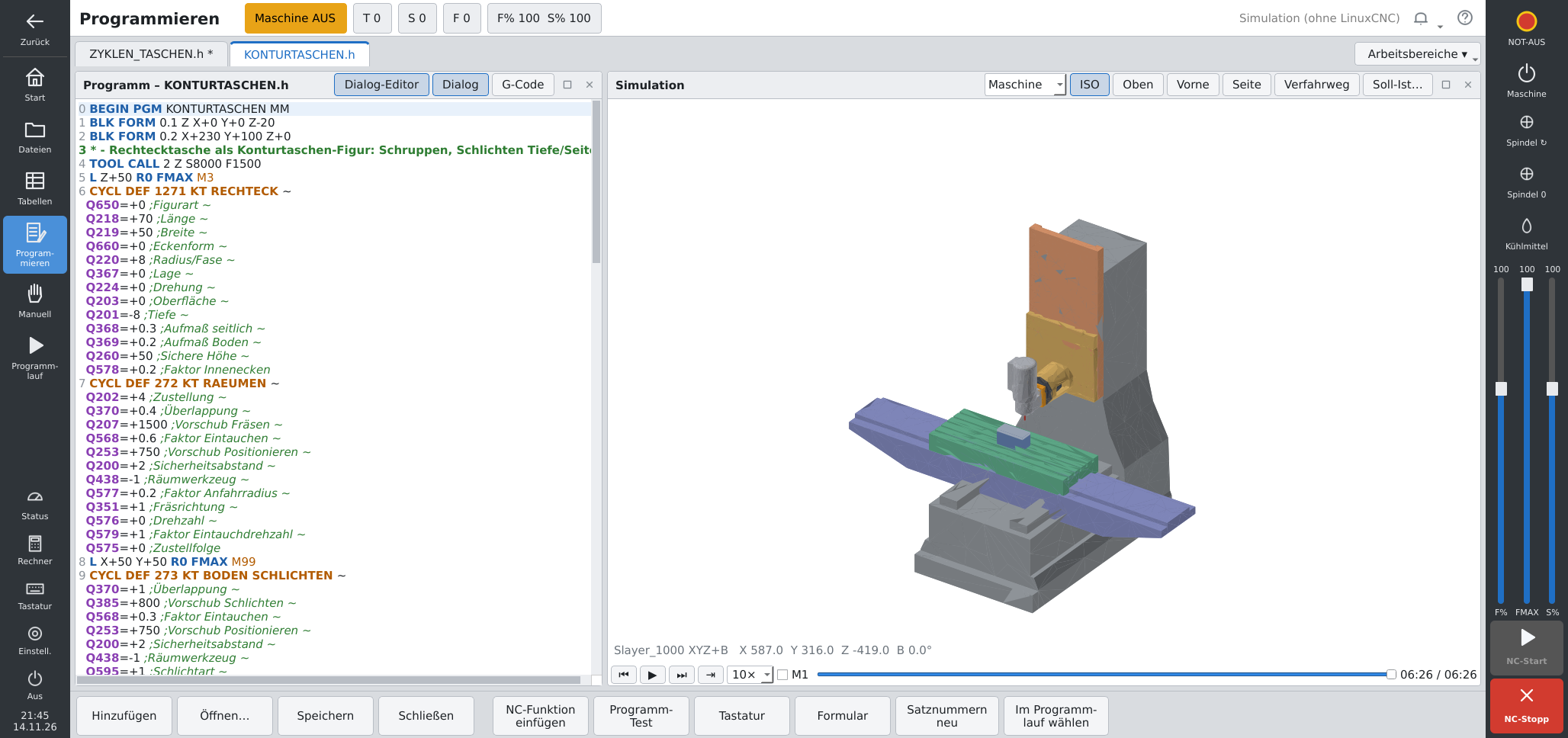
- Simulation with toolpath lines, material removal, full machine model and target/actual comparison against STL
- Checks for limit switches, rapid moves in material, holder collisions and head/table collisions
- Sim machines: 4-axis XYZ+B swivel head (my Slayer_1000) and 5-axis XYZAC
Important: Unmodified LinuxCNC runs underneath. Only G-code is executed on the machine. No third-party software or data is included. The goal is simply to make operation easier for everyone who is used to conversational programming.Next steps: First use on the real machine (EtherCAT, lean system that boots directly into the GUI) and connecting an original matrix keyboard via Arduino.Feedback and ideas are welcome!
There's still a lot to do, test and expand before this becomes a full-featured GUI, but the first tests on the machine look good.The screenshots are numbered in the order they appear in the text:- Cycle with input form
- G-code view
- Material removal simulation
- Machine simulation
- Programming run → Program run
Last edit: 15 Nov 2026 00:44 by Sviper.
The following user(s) said Thank You: 0x2102, elizacommunities
Please Log in or Create an account to join the conversation.
- Miti
- Offline
- New Member
-

Less
More
- Posts: 1
- Thank you received: 0
15 Nov 2026 12:04 #350728
by Miti
Replied by Miti on topic LCNC-Cyclo: Conversational Programming for LinuxCNC
Hi,
first of all, great job on this! The interface looks really clean and well thought out. I’ve actually been looking for a UI like this for LinuxCNC for quite a while, especially one that brings that familiar shop-floor workflow (like Heidenhain) to an unmodified LinuxCNC setup without hiding the underlying G-code.
I have a few technical questions about the project:
Best regards
first of all, great job on this! The interface looks really clean and well thought out. I’ve actually been looking for a UI like this for LinuxCNC for quite a while, especially one that brings that familiar shop-floor workflow (like Heidenhain) to an unmodified LinuxCNC setup without hiding the underlying G-code.
I have a few technical questions about the project:
- Tech stack: What framework or toolkit is LCNC-Cyclo built on (e.g., Python/PyQt, QtVCP, QML, or something standalone communicating via the LinuxCNC Python interface)?
- Testing: Is there already a way to test an early version, or do you plan on looking for beta testers once you've finished your initial tests on the real machine?
- Open Source: Do you plan to publish the repository and make the project open source later on?
Best regards
Please Log in or Create an account to join the conversation.
- Sviper
- Offline
- Senior Member
-
Less
More
- Posts: 79
- Thank you received: 13
16 Nov 2026 14:22 #350758
by Sviper
Replied by Sviper on topic LCNC-Cyclo: Conversational Programming for LinuxCNC
Hi, thanks a lot for the kind words!
Tech stack: It’s plain Python 3 with PyQt5. It’s a standalone display, not QtVCP or QML. It talks to LinuxCNC through the regular linuxcnc Python module and is set as DISPLAY in the INI file. The conversational programs are translated into normal LinuxCNC G-code by a separate translator. The cycles are plain .ngc subroutines. The simulation (material removal, machine model, collision checks) uses numpy.
LinuxCNC itself is only changed in a very small way. So far the only addition is a new kinematics module for my machine: src/emc/kinematics/xyzbh-kins.c (XYZ plus a B swivel head parallel to Y). It can switch between direct axis mode and TCP via switchkins. Everything else is standard LinuxCNC.
Cycles: All cycles were written completely from scratch, and no code from other projects went into them. That also means they are still at a first-iteration stage. They will most likely need a few more rounds of refinement, and later on help from testers to improve them.
Testing: Not yet, sorry. First I want to reach a state where my own test machine runs safely and has all the basic functions you need for productive work. That doesn’t mean every cycle is fully tested, but the essentials have to be there. Once that’s done, I’ll open it up, and beta testers will be very welcome.
Open source: Yes, definitely. The whole project will be released as open source, including all modules, subroutines and cycles, so it’s freely available to everyone. Since it’s based on LinuxCNC, it will follow LinuxCNC’s licensing (GPL). The repository will go public at the same time as the first test version.
Language: The UI has already been translated into English, and the English help/documentation will follow soon.
I’ll post updates here as things progress on the real machine.
Best regards
The following user(s) said Thank You: tommylight
Please Log in or Create an account to join the conversation.
Time to create page: 0.171 seconds