
- Posts: 321
- Thank you received: 84

Please Log in or Create an account to join the conversation.
Please Log in or Create an account to join the conversation.
My experience has been analog +/-10V servo control configs were a lot more labor intensive to get right compared to step/direction via parallel port or mesa boards driving open loop steppers (easy) or ethercat (a bit of network configuration plus some xml file programming). My analog servo configs have all been... quite a journey.Thanks for the explanation, that makes sense for your setup.
When I mentioned cost, I wasn’t really thinking only about the price of the drives themselves. The hardware can indeed be quite cheap nowadays, especially the Chinese EtherCAT kits. What I had more in mind was the total cost: time spent integrating, debugging, dealing with CiA402 states, homing behavior, synchronization issues, and so on. In LinuxCNC, that complexity is very real, as I’m sure you know.
For my own projects, I’m not looking at EtherCAT as something that would “upgrade” my machine in a practical sense. If I end up buying an EtherCAT drive, it would be purely to learn and experiment with the technology, not because it necessarily adds value compared to a Mesa + step/dir or ±10V setup, which are already very robust and proven.
Please Log in or Create an account to join the conversation.
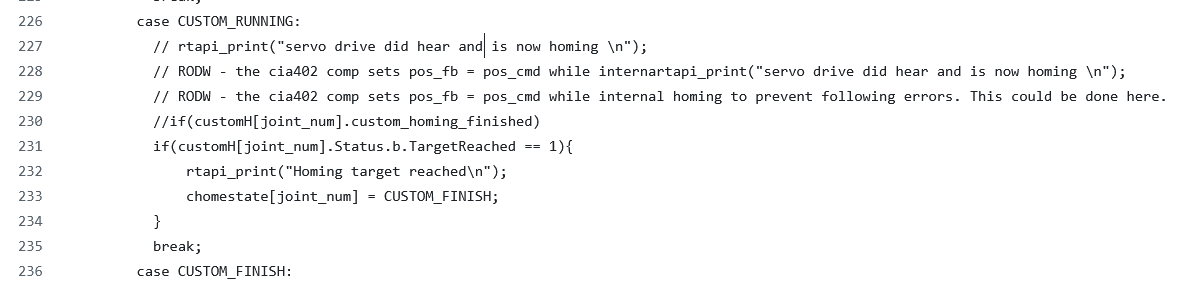
Back after my IP being banned for a week! (Thanks for letting me out of Jail Andy!)From what it looks like, the only way out from homing is that is finishes.
This could probably be expanded to include error states and whatever can occur.
Please Log in or Create an account to join the conversation.
Please Log in or Create an account to join the conversation.
Please Log in or Create an account to join the conversation.

