
- User Interfaces
- Other User Interfaces
- QtPyVCP
- LatheEasyStep – experimental QtVCP macro for step-by-step lathe programming
LatheEasyStep – experimental QtVCP macro for step-by-step lathe programming
- aDm1N
-
 Topic Author
- Online
- Junior Member
-

Less
More
- Posts: 39
- Thank you received: 5
15 Dec 2025 12:19 - 15 Dec 2025 12:51 #340123
by aDm1N
LatheEasyStep – experimental QtVCP macro for step-by-step lathe programming was created by aDm1N
Hi all,
I want to share an experimental QtVCP macro I am currently working on:
LatheEasyStep.
It is embedded into the QtDragon lathe panel and aims to simplify
lathe programming by replacing manual G-code writing with a structured,
step-by-step workflow (facing, contouring, parting, threading, drilling,
keyways, etc.).
Each operation is configured in its own tab with tool, spindle, feed,
coolant and geometry parameters. The macro then generates a complete
lathe program, including comments and basic safety moves.
Important notes:
- This project is NOT finished.
- The G-code generation still needs restructuring and improvement.
- I built the first working version with the help of AI, then refined it
manually. I am very aware that this often leads to suboptimal structure,
which is exactly why I am asking for feedback.
What I am especially looking for:
- Suggestions for a cleaner G-code generation architecture
- Common LinuxCNC lathe pitfalls I should explicitly handle
- Ideas for improving safety, validation, and workflow
- General QtVCP / QtDragon best practices
The project is GPL licensed and available here:
github.com/peter-pan08/LatheEasyStep
Critical feedback is explicitly welcome. I am more interested in doing it
right than doing it quickly.
Thanks in advance!
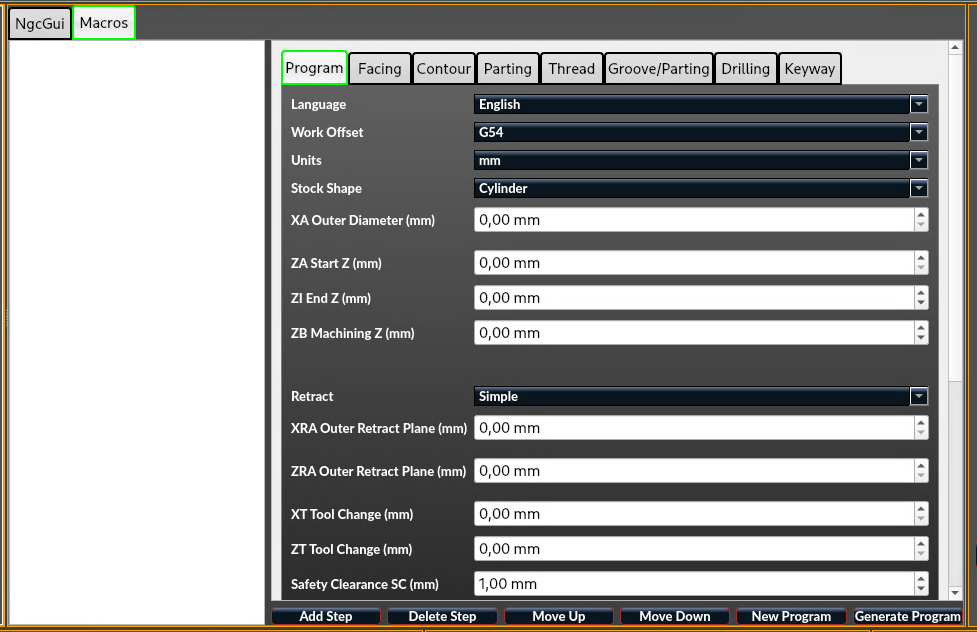
I want to share an experimental QtVCP macro I am currently working on:
LatheEasyStep.
It is embedded into the QtDragon lathe panel and aims to simplify
lathe programming by replacing manual G-code writing with a structured,
step-by-step workflow (facing, contouring, parting, threading, drilling,
keyways, etc.).
Each operation is configured in its own tab with tool, spindle, feed,
coolant and geometry parameters. The macro then generates a complete
lathe program, including comments and basic safety moves.
Important notes:
- This project is NOT finished.
- The G-code generation still needs restructuring and improvement.
- I built the first working version with the help of AI, then refined it
manually. I am very aware that this often leads to suboptimal structure,
which is exactly why I am asking for feedback.
What I am especially looking for:
- Suggestions for a cleaner G-code generation architecture
- Common LinuxCNC lathe pitfalls I should explicitly handle
- Ideas for improving safety, validation, and workflow
- General QtVCP / QtDragon best practices
The project is GPL licensed and available here:
github.com/peter-pan08/LatheEasyStep
Critical feedback is explicitly welcome. I am more interested in doing it
right than doing it quickly.
Thanks in advance!
Attachments:
Last edit: 15 Dec 2025 12:51 by aDm1N. Reason: add pic
The following user(s) said Thank You: tommylight
Please Log in or Create an account to join the conversation.
- cmorley
- Away
- Moderator
-

Less
More
- Posts: 7244
- Thank you received: 2109
15 Dec 2025 13:53 #340127
by cmorley
Replied by cmorley on topic LatheEasyStep – experimental QtVCP macro for step-by-step lathe programming
This should be moved to the Qtvcp section.
Looks promising! Keep is updated! If you get stumped with the programming i can try to help.
Looks promising! Keep is updated! If you get stumped with the programming i can try to help.
Please Log in or Create an account to join the conversation.
Moderators: KCJ, Lcvette
- User Interfaces
- Other User Interfaces
- QtPyVCP
- LatheEasyStep – experimental QtVCP macro for step-by-step lathe programming
Time to create page: 0.080 seconds