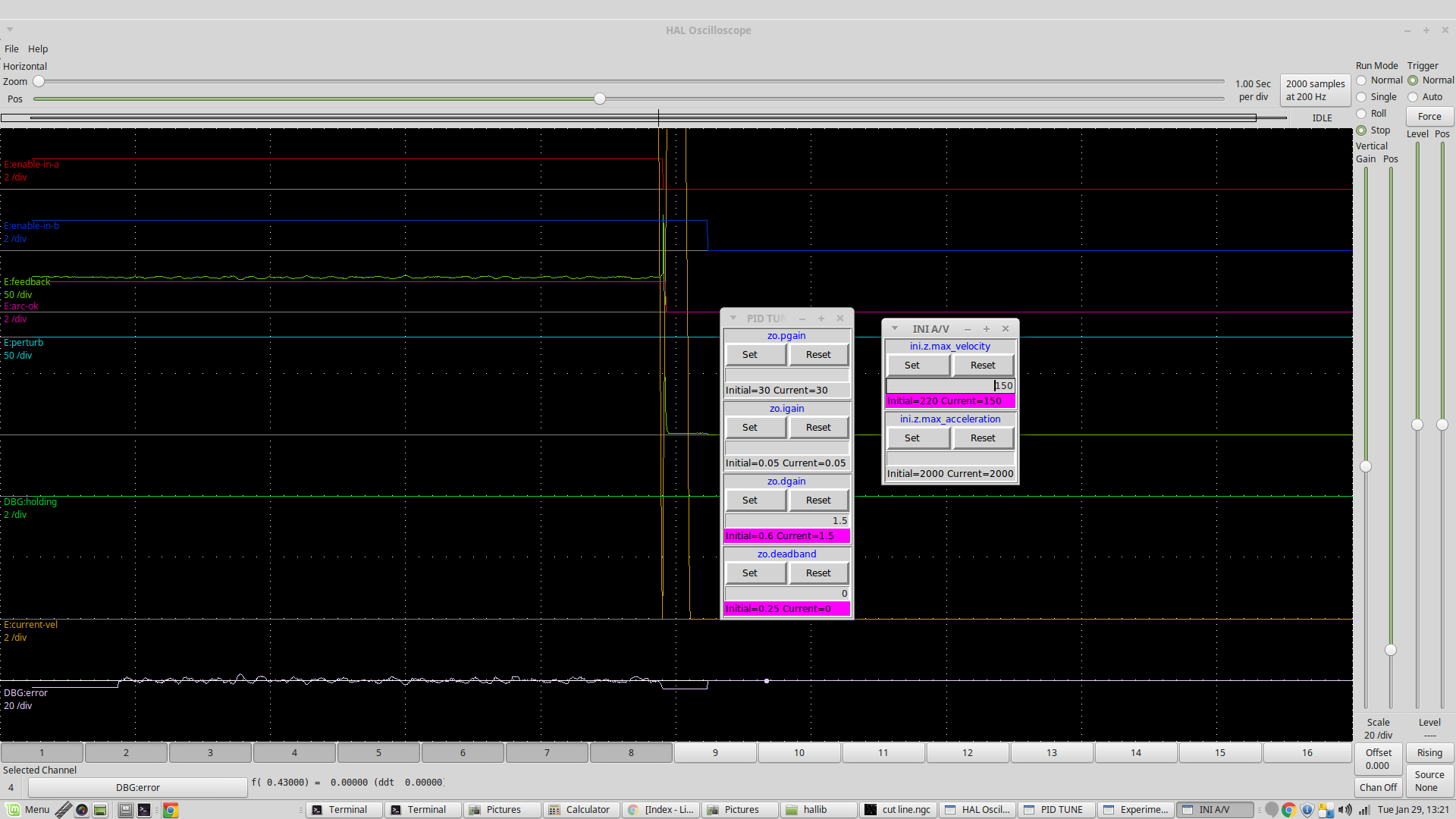
Thanks guys. I'm not really sure if reducing the acceleration response will help much with the model I'm using. Here is a plot with reduced acceleration and greater oscillation
You can compare that with plots a couple of pages ago.
Tommy, I'm not really a hardware guy and Dewey cautioned against any type of filtering. I know Peter suggests a lowpass filter on the torch volts which I have not added. Skunkworks mentioned PCW suggested a lowpass gain of 0.02 from memory. If you go back a couple of pages, you will see a voltage plot with no THC and its very smooth. The other smoothing technique used in plasma is to compute a moving average. I've written a component to do this for kerf crossing and I was going to break it out as a standalone component.
The more I think about this, the eoffset counts are held in an accumulator register that is reduced every time the counts are applied to the trajectory. This is fine in a geometric sense if you are machining a cam lobe as its a steady state but in the case of torch volts, we have a random signal. I kind of think that the offset adjustments are stacking up before the hardware can fully apply the adjustment. I think I will write a skip component that if configured for say a skip 3, it will hold the eoffset adjustment to zero for two cycles and then apply an adjustment on the third. The offsets will still be correctly calculated but hopefully, the hardware has time to reach its adjusted position.
Then the next approach might be to scale the offset before applying it.