Rods "Spaceship" Scratch built Plasma Cutter build

More
7 years 9 months ago - 7 years 9 months ago #125325 by rodw
John, yes, the eoffsets is now documented in the master branch motion component.
linuxcnc.org/docs/devel/html/man/man9/motion.9.html
Basically the counts are added to an internal register and each count is scaled and used to adjust the axis position.

The voltage in that last post is holding to within a 2 volt range and oscillating at about 4 Hz vs a nervous 8-9 Hz a few days ago. Earlier in this thread I posted a graph from my old machine that showed a linear relationship of 7.53 V/mm (or 0.132 mm/volt). I'm going to assume this machine is similar as the last config seemed to work OK on it. So the 2 volt range is well within spec at +- 0.13mm as I quoted in my last post. So it would seem that from what you've said this morning (on my side of the world) is we are now well within spec so I think its about time I started to lock this config down.

On this thread which I started right at the beginning of my build, Tommy quotes some acceleration settings he uses.
forum.linuxcnc.org/30-cnc-machines/31509...pinion-drive?start=0
In an effort to get better tracking we pushed the velocity and acceleration way past that. So now in the light of a heavier torch and observing that we halved the oscillation frequency at slower velocity and acceleration, I think I'll retreat to
60mm/sec velocity and 700 mm/sec/sec or less acceleration and see what happens.

I thought I should plot the external offset count inputs to see how big of an adjustment we are asking for each servo cycle. I quite like the idea Phill suggested of applying a limit on the counts requested. To accelerate from 0 to 60 mm/sec will take 7 servo cycles on in the case of a reversal of direction, thats 1.4 seconds if at full velocity (which I doubt will be reached). At 60 m/sec, the maximum counts that can be executed per servo cycle is 23. I think i will tweak my component posted earlier to allow a limit to be applied to a S32.

Finally, I think I will enhance my component that scales the THCAD voltage to include low pass filtering PCW suggests and also to move my average volts code into this component so there are a couple of methods to smooth the arc voltage input.

Phew, sorry about my ramblings!

Last edit: 7 years 9 months ago by rodw.

Please Log in or Create an account to join the conversation.

More
7 years 9 months ago #125341 by islander261
Rod

Thanks, I am aware of the newer entries in the sparse at best motion documentation. I was hoping that one of the code wizards will look up in the code and confirm that EO works like the jogging input. I just don't know how to follow the changing variable names through the succession of files.

You can limit the actual EO counts but I think it will be more effective to use a limit2 or limit3 component depending on where it is placed. I know at least one implementation that uses three different fixed levels plus one user settable acceleration limits that are chosen depending on sheet thickness and cutting speed.

I think you are well within the sweet spot with your +/-2volt ripple using the TD equipment.

John

Please Log in or Create an account to join the conversation.

More
7 years 9 months ago #125348 by Mike_Eitel
Hi Rod
Just by curiosity.
Do you know what mechanical resonating frequency you z axis has?
Mike

Please Log in or Create an account to join the conversation.

More
7 years 9 months ago #125356 by islander261
All

Ok, I found the answer in control.c.
Code:
... new_eoffset_counts = *(axis_data->eoffset_counts); delta = new_eoffset_counts - axis->old_eoffset_counts; axis->old_eoffset_counts = new_eoffset_counts; ... axis->ext_offset_tp.pos_cmd += delta * *(axis_data->eoffset_scale); ...

So yes it does act like a jog wheel.

John

Please Log in or Create an account to join the conversation.

More
7 years 9 months ago - 7 years 9 months ago #125362 by rodw
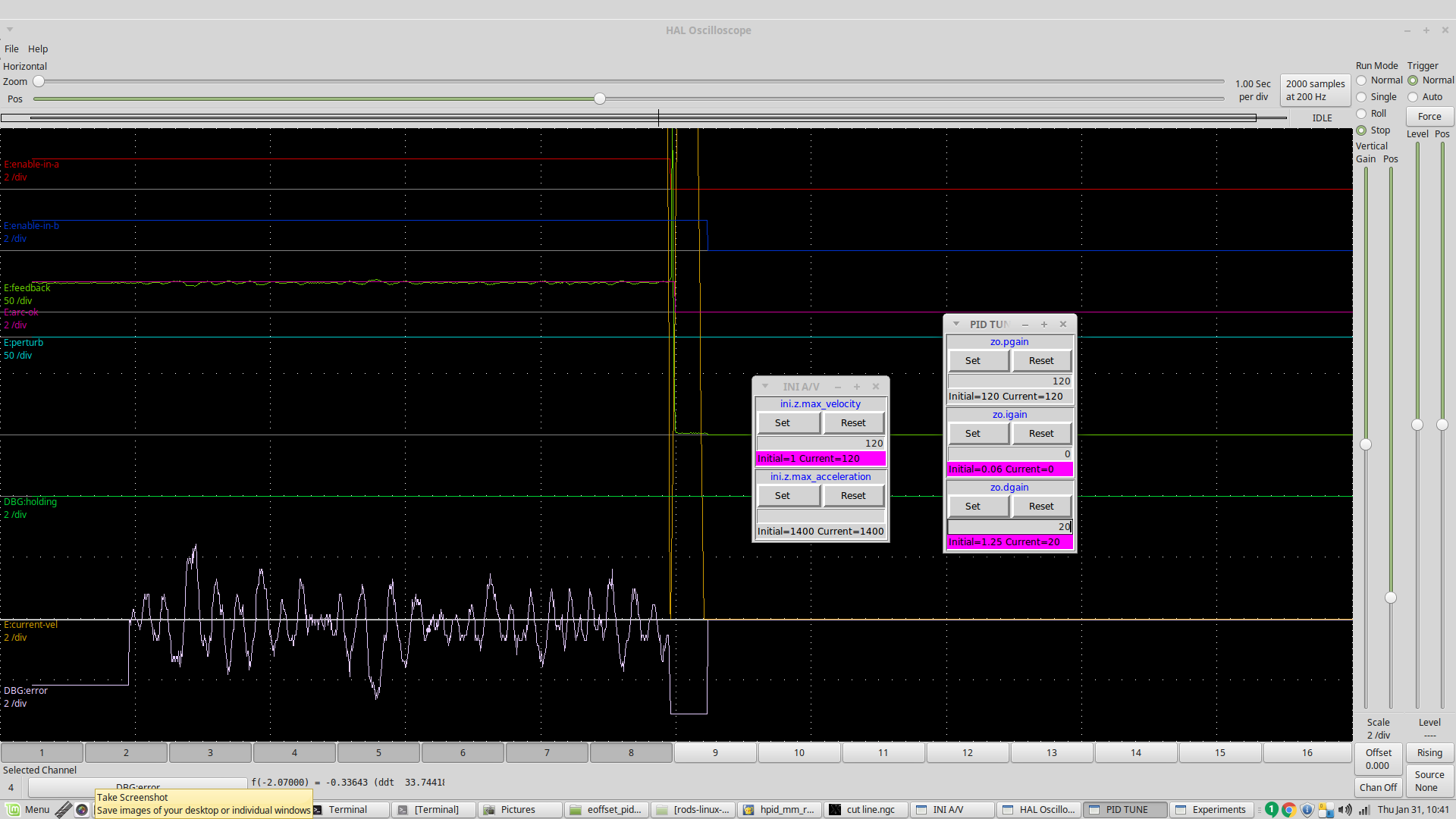
Well I think I will go with this one.


The error line at the bottom is a 2 volt/division scale stays within +- 2 volts but most of the time its better than that.

I did get tighter control than this at the expense of more busyness!

I did try the lowpass filter thats a bad idea with external offsets. I ended up with very large (but smooth) oscillations
Last edit: 7 years 9 months ago by rodw.

Please Log in or Create an account to join the conversation.

More
7 years 9 months ago #125363 by islander261
Rod

Yes, that was my experience with any lowpass filtering of the arc voltage, either digital or analog before the THCAD. I am thinking that the 6hz-7hz is way below any typical noise source so it must be related to something mechanical or in the plasma power supply. Have you tried the THCAD with a 1:1 output? If any thing noting any change may help pinpoint the source. Have you checked the error voltage at fixed height again after all the changes? Have you checked the actual distance the torch is moving while cutting under THC? Seeing the phase relationship between the error voltage/counts and the change in torch distance will give a clue which way to move with tuning the response. No matter what I did the voltage lagged the distance (commanded steps).

The eoffset PID component probably needs to be re tuned for each new set of output response limiting, especially the D term. I know Dewey put in some pins to make the imperial and metric scales close to reacting the same. I have no idea if it works correctly. I think your gains looks a little high. For the slope of my error volts to distance curve a P gain of 10 to 11 looks to be a good starting place, for some reason you are a factor of 10 greater than that. With your TD torch I would expect your gain numbers to be about twice mine if the imperial/metric compensation works correctly. Of course all this is out the window if you are good with your cut quality.

John

Please Log in or Create an account to join the conversation.

Time to create page: 0.558 seconds
Powered by Kunena Forum