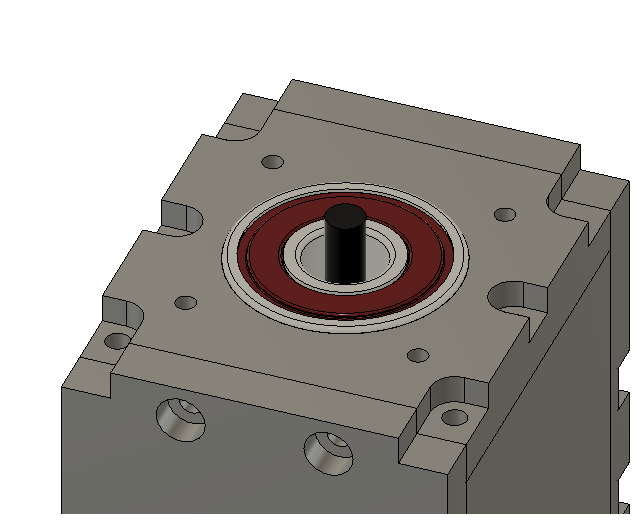
a homing sensor is already placed on my TC prototyp
The homing sensor you've shown is not likely to work well. You have it pointed at a small diameter shaft, and I'm inferring that you have a hole or some other flag to trigger the sensor. Proxys are remarkably accurate, but the further away from the axis of rotation you move the proxy & flag, the more accurate the final position will be. As drawn, the proxy will trigger (and thus your home position) with perhaps +/- half a degree of rotation depending on speed, flag shape, etc. and that will result in a significant deviation at the outer radius of the platter.
I suggest you mount the sensor to the outside of the carrier housing on a bracket, and use one of the pocket mounting screws as a flag. If you mount two sensors on a single bracket (one above the other), one of the pocket screw flags can be longer than the rest and act as a home flag.
Make the sensor bracket adjustable so you can fine-tune the home rotational position and sensor-to-flag distance.
Moving on:
So... no arduino...Ok.
Now that you've decided on using a stepper, what have you decided regarding the drive system?
Planetary reducer, geneva wheel, something else? Your answer will determine the control scheme used to rotate the platter.
As to the mesa card any of the ones you've mentioned should be sufficient to easily add another step output, but make a list of your IO requirements and see if you need more (or want more in the future).
Here's the IO I have that is specific to my ATC. I mentioned this earlier - your level of comfort may vary regarding safety:
- Sensors
- Step drive alarm (using closed-loop drive)
- platter home sensor
- pocket sensor
- Power draw bar cylinder extended
- Power draw bar cylinder retracted
- spindle lock cylinder extended
- spindle lock cylinder retracted
- carousel slide extended
- carousel slide retracted
- carousel chip cover door open
- Actuators (air solenoid valves)
- PDB active (spring return valve)
- carousel slide extend
- carousel slide retract
- chip cover door open (spring return valve)
- tool holder taper chip blast
- spindle lock cylinder (spring return valve)
IO I don't have, but probably should
- tool in pocket sensor
- Used to sense if a tool is in the pocket so we don't crash a loaded pocket in to a loaded spindle
- "That cant happen if the toochange sequence is programmed properly"
- Um... yes it can. If you tell LCNC the spindle is unloaded at the end of the day but forget to take the tool out of the spindle... and then try to do a tool change in the morning....crash.
- Anything that can reduce the chance of operator error causing a crash is good.
- Can't (easily) be a proxy as those need to be so close to the tool holder that the spindle will likely interfere. Some sort of laser maybe?
- power draw bar fully up sensor
- BT30 taper holders can be 'grabbed' by the draw bar but not lined up with the spindle drive dogs - a dangerous condition as the tool isn't engaged with the taper
- I'm using the air cylinder position to monitor PDB condition, but because the cylinder ram isn't directly connected to the PDB my sensor assumes the tool is completely engaged in the taper.
- Same issue with the tool-in-pocket sensor: very little room for a proxy, and there isn't much difference in height between a partly-engaged drawbar and a fully-seated one.
- CNC_ANDI's ISO30 spindle won't have this issue, but I mention it for anyone else reading this later.
So next step is for you (CNC_ANDI) to figure out your mechanical drive system and IO requirements.