It's been a while since I've had an update to the spaceship but with the help of PCW and his new THCAD-5 which he kindly donated for the experiment, I'd like to introduce to you hypersensing which is ohmic sensing on steroids for Linuxcnc!
So PCW wrote some new firmware for the 7i76e and 7i96 especially designed for plasma machines. What he did was to include 3 encoder A's (on the encoder A, encoder B and Index signals). So this means you can add up to 3 THCAD cards to the one Mesa motion control card. The relevant bit files are available for download on the Mesa web site. The file names end in
pl.bit
mesanet.com/software/parallel/7i80.zip
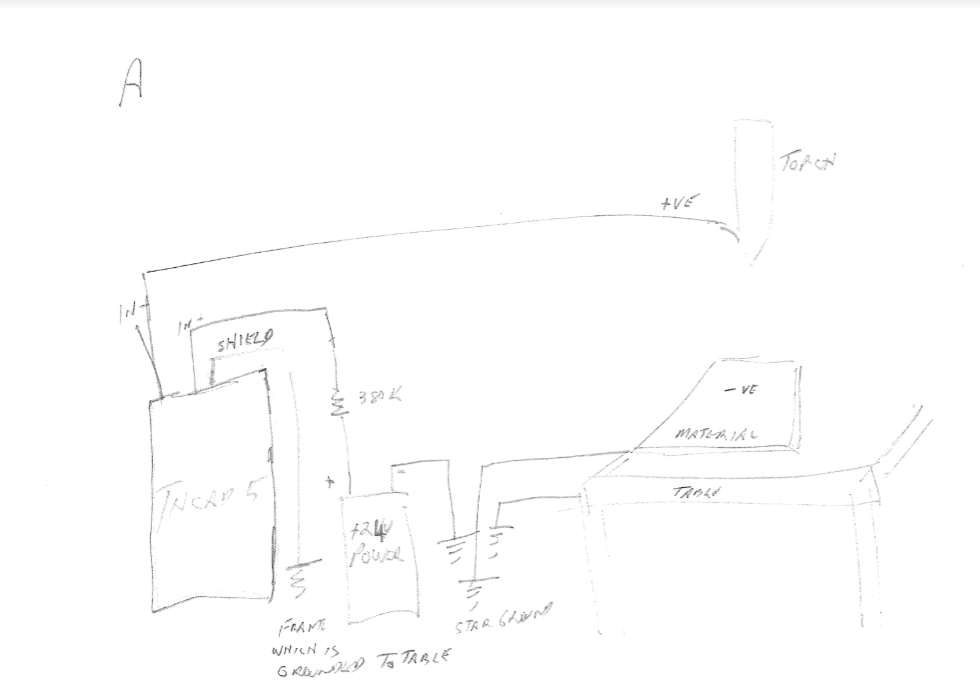
So after a couple of iterations, we came up with a circuit that works perfectly for ohmic/hyper sensing when used with a component I wrote. So we took an isolated 24 volt power supply and connected it to the table star ground. The positive side of the power supply passes through a 390K resistor then onto a THCAD5 like this.
Ooops, that resistor value is wrong.
This circuit with a 390k resistor gives us a 24.5 volt full scale reading, just a bit over the power supply voltage.
Peter's theory was that by using the THCAD, we might be able to see some voltage loss that would allow us to calculate circuit resistance. What I found was that when probing material, the voltage rose from 0 volt through to 24 volts over 0.04mm of Z axis travel. (something like 0v, 12v, 18v, 24V per 0.1mm). Then I tested the 24V relays we were using on a variable power supply and found they turned on at about 7.5 volts and off at about 5 volts and we had some feedback that said this was a bit too sensitive.
So I wrote a component that allowed us to measure the hyper sensing circuit voltage that increased this hysterisis. It uses two pins, one to define an upper threshold that had to be exceeded before the probe signal was triggered. Initially I just had one threshold. I picked 18 volts but I think it could be set as high as 22 volts.
After thinking about this for a while, I concluded the sensing would be more robust if we added a lower threshold of some where between 1 to 5 volts. I figured that by doing this , the wide hysteresis gap from 5-18 volts would mean that there would be no chance of spurious probing triggers. So I got this wired in pretty much permanently today and I am very happy with the results.
I did quite a bit of cutting yesterday and it worked very well and today I added the lower threshold which I set 5 volts and it still worked perfectly. I think the THCAD is much more responsive then my relay based ohmic sensing and it was not going to such.
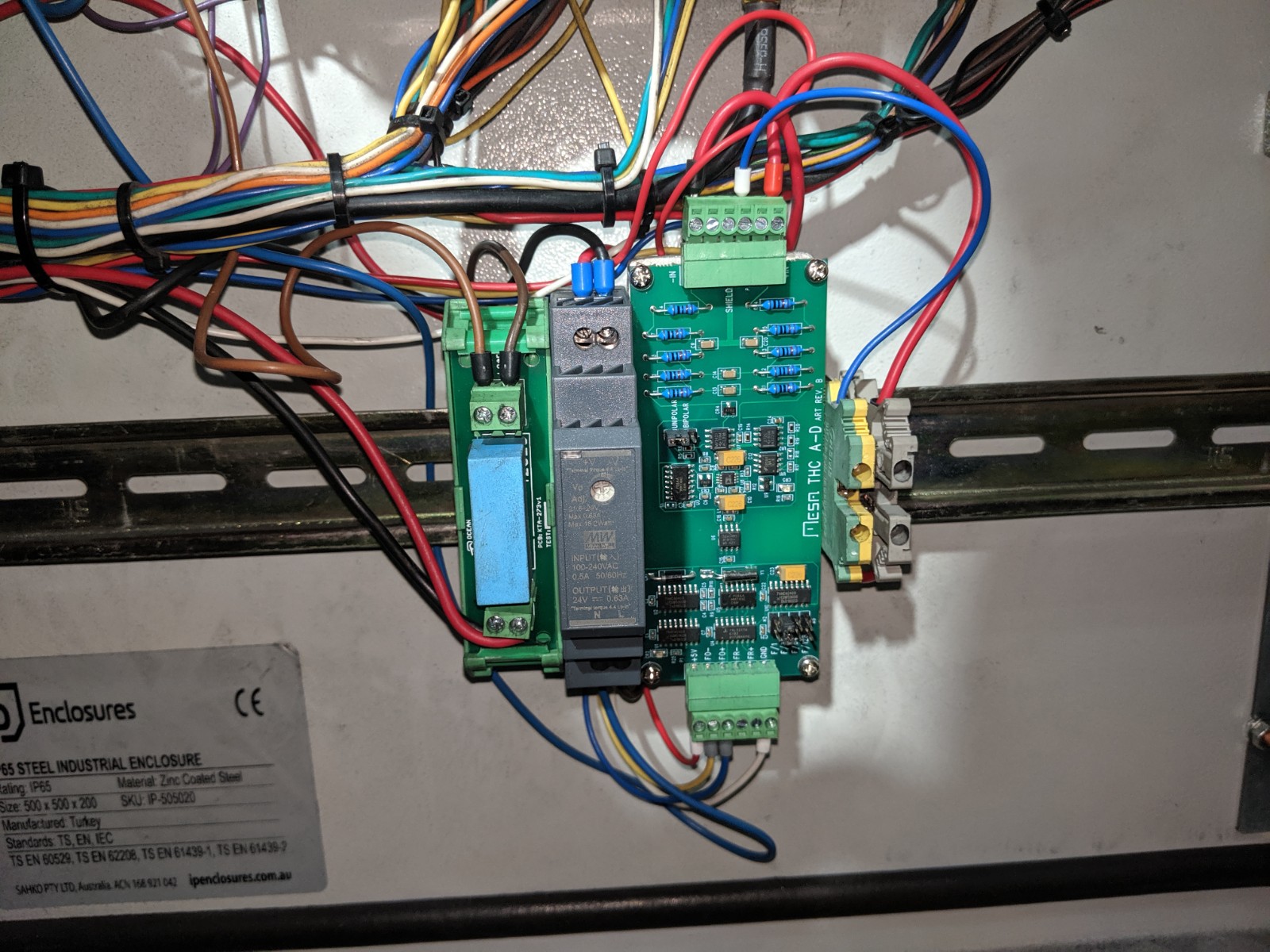
So back to the photo from left we have:
- 240 V AC relay (optional)
- 24V isolated power supply
- THCAD-5
- Grounding point
- modified terminal block including THCAD scaling relay
So its early days but the THCAD seems to be much more responsive than my old relay style output, Its also much easier to wire in and is more responsive than just relays.