
Considering a Full Rewire on a Working Schaublin 125 CNC
- RotarySMP
-

- Offline
- Platinum Member
-

Less
More
- Posts: 1635
- Thank you received: 595
23 Apr 2026 11:53 #345873
by RotarySMP
Replied by RotarySMP on topic Considering a Full Rewire on a Working Schaublin 125 CNC
Has that bug been reported to the Devs?
Please Log in or Create an account to join the conversation.
- spumco
- Offline
- Platinum Member
-
Less
More
- Posts: 2180
- Thank you received: 905
23 Apr 2026 16:36 - 23 Apr 2026 16:40 #345879
by spumco
github.com/LinuxCNC/linuxcnc/issues/3455#issue-3089348330
There's another spindle synchronization bug, possibly related, that I encountered at the same time last year. @Aciera found a workaround for it, but I don't know if the two are related.
github.com/LinuxCNC/linuxcnc/issues/3556#issue-3398986003
I don't have the skills to really figure out what's causing the two problems, much less contribute to a fix.
EDIT - I somehow messed up pasting the forum links when I first reported the bug, but one can highlight the link and right-click to open the forum thread.
Replied by spumco on topic Considering a Full Rewire on a Working Schaublin 125 CNC
Yes.Has that bug been reported to the Devs?
github.com/LinuxCNC/linuxcnc/issues/3455#issue-3089348330
There's another spindle synchronization bug, possibly related, that I encountered at the same time last year. @Aciera found a workaround for it, but I don't know if the two are related.
github.com/LinuxCNC/linuxcnc/issues/3556#issue-3398986003
I don't have the skills to really figure out what's causing the two problems, much less contribute to a fix.
EDIT - I somehow messed up pasting the forum links when I first reported the bug, but one can highlight the link and right-click to open the forum thread.
Last edit: 23 Apr 2026 16:40 by spumco. Reason: clarity
The following user(s) said Thank You: RotarySMP, tommylight, Dudelbert
Please Log in or Create an account to join the conversation.
- Dudelbert
- Offline
- Senior Member
-

Less
More
- Posts: 79
- Thank you received: 20
24 Apr 2026 14:44 - 24 Apr 2026 14:53 #345896
by Dudelbert
Replied by Dudelbert on topic Considering a Full Rewire on a Working Schaublin 125 CNC
I had time to test some more today.
Let me start with a big thanks for the great, helpful feedback.
I started trying some runs with G33. Multiple runs with the same settings resulted in only one tool mark.
Increasing the RPM did in fact result in a slightly lagging toolpath (cutting on the right side of the insert).
This was not very pronounced, even between 100 and 900 RPM the difference was visible, but not more than a few tenths of a mm.
At 2000 RPM, the new tool marks were close to the middle between the earlier ones. But I don’t really intend to thread at 2000 RPM anyway.
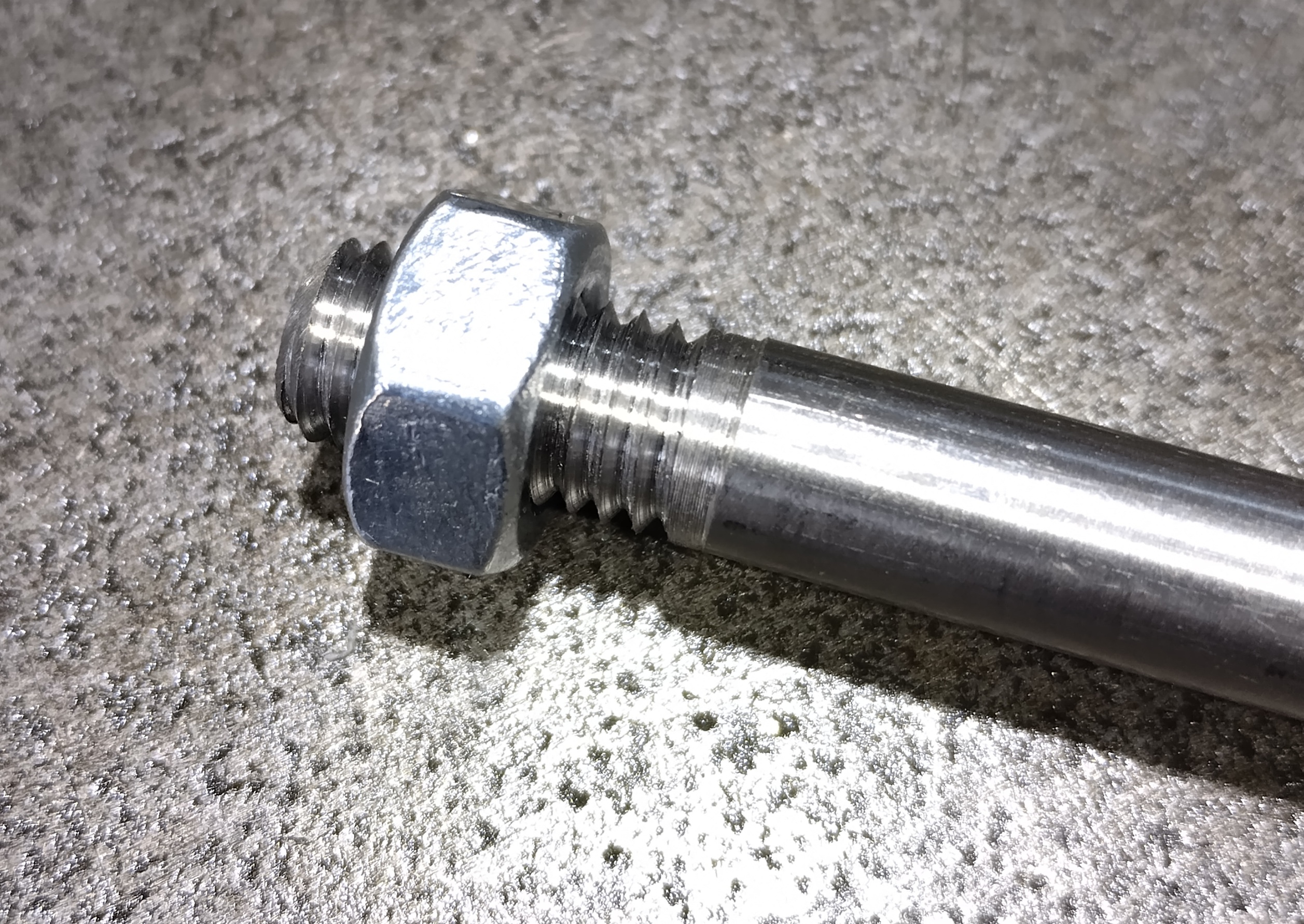
Going back to G76, but with Q, H, E, and L all set to 0, gave me my first nice thread.
Reintroducing Q29 still gives a nice thread and cuts on the left of the insert, as one would expect.
H2 also still worked, and after that E0.75 but L0 gave the same good result.
So only L2 was left, and I am now using the same G76 line as before, so this has to be the problem.
But no it also cuts fine.
At this point, I am uncertain if I should be happy that I can cut threads now or worried that I have no idea what was wrong until now.
I cannot think of anything I changed in between.The only thing is, I had a look at the belt connecting the spindle to the encoder.
I had this apart and inspected, checked the belt (nothing notable to see), and put it back together. I don’t think that should have changed anything, maybe slightly different belt tension?
Let me start with a big thanks for the great, helpful feedback.
I started trying some runs with G33. Multiple runs with the same settings resulted in only one tool mark.
Increasing the RPM did in fact result in a slightly lagging toolpath (cutting on the right side of the insert).
This was not very pronounced, even between 100 and 900 RPM the difference was visible, but not more than a few tenths of a mm.
At 2000 RPM, the new tool marks were close to the middle between the earlier ones. But I don’t really intend to thread at 2000 RPM anyway.
Going back to G76, but with Q, H, E, and L all set to 0, gave me my first nice thread.
Reintroducing Q29 still gives a nice thread and cuts on the left of the insert, as one would expect.
H2 also still worked, and after that E0.75 but L0 gave the same good result.
So only L2 was left, and I am now using the same G76 line as before, so this has to be the problem.
But no it also cuts fine.
At this point, I am uncertain if I should be happy that I can cut threads now or worried that I have no idea what was wrong until now.
I cannot think of anything I changed in between.The only thing is, I had a look at the belt connecting the spindle to the encoder.
I had this apart and inspected, checked the belt (nothing notable to see), and put it back together. I don’t think that should have changed anything, maybe slightly different belt tension?
Last edit: 24 Apr 2026 14:53 by Dudelbert.
The following user(s) said Thank You: RotarySMP
Please Log in or Create an account to join the conversation.
- tommylight
-

- Offline
- Moderator
-

Less
More
- Posts: 21980
- Thank you received: 7481
24 Apr 2026 15:13 #345897
by tommylight
Replied by tommylight on topic Considering a Full Rewire on a Working Schaublin 125 CNC
Seems like encoder failing to count at higher speeds, might be interference, or encoder slotted wheel dirt/rust, or encoder input lagging, or encoder outputs marginally low output.
I have also seen a perfectly good encoder counting on one direction, and one channel going all wonky on the other direction, it was new so i returned it without the chance of figuring out what was wrong with it.
I have also seen a perfectly good encoder counting on one direction, and one channel going all wonky on the other direction, it was new so i returned it without the chance of figuring out what was wrong with it.
The following user(s) said Thank You: RotarySMP, Dudelbert
Please Log in or Create an account to join the conversation.
- Dudelbert
- Offline
- Senior Member
-
Less
More
- Posts: 79
- Thank you received: 20
03 May 2026 14:01 #346136
by Dudelbert
Replied by Dudelbert on topic Considering a Full Rewire on a Working Schaublin 125 CNC
I was at it again today.
Threading does not work again, absolutely the same behavior as before.This time I could try G33 with the problem present. Running the exact same code multiple times, every subsequent run cut slightly to the right of the last by very even amounts.Now I am really confused. It worked a few days ago. That day it worked over and over, and now it does not work at all.
RPM does not seem to make a noticeable difference, or at least it does not work no matter how low I go.I don’t even have an idea what that tells me. The hardware is obviously capable of working. Is it some intermittent contact somewhere?The encoder being the problem is really the only thing that makes sense to me, but all tests I did point to it being OK.If anyone has an idea what I should test to find this, I would highly appreciate it.
Threading does not work again, absolutely the same behavior as before.This time I could try G33 with the problem present. Running the exact same code multiple times, every subsequent run cut slightly to the right of the last by very even amounts.Now I am really confused. It worked a few days ago. That day it worked over and over, and now it does not work at all.
RPM does not seem to make a noticeable difference, or at least it does not work no matter how low I go.I don’t even have an idea what that tells me. The hardware is obviously capable of working. Is it some intermittent contact somewhere?The encoder being the problem is really the only thing that makes sense to me, but all tests I did point to it being OK.If anyone has an idea what I should test to find this, I would highly appreciate it.
Please Log in or Create an account to join the conversation.
- RotarySMP
-
- Offline
- Platinum Member
-
Less
More
- Posts: 1635
- Thank you received: 595
04 May 2026 04:52 #346147
by RotarySMP
Replied by RotarySMP on topic Considering a Full Rewire on a Working Schaublin 125 CNC
Could the coupling between the Z axis motor and ball screw be slipping?
The following user(s) said Thank You: Dudelbert
Please Log in or Create an account to join the conversation.
- Dudelbert
- Offline
- Senior Member
-
Less
More
- Posts: 79
- Thank you received: 20
04 May 2026 07:03 #346149
by Dudelbert
Replied by Dudelbert on topic Considering a Full Rewire on a Working Schaublin 125 CNC
I don’t think it can be the Z-axis clutch, as I have a glass scale on Z.
So a slipping clutch should either be corrected or, more likely, end in a stop due to following error.
So a slipping clutch should either be corrected or, more likely, end in a stop due to following error.
The following user(s) said Thank You: RotarySMP
Please Log in or Create an account to join the conversation.
- RotarySMP
-
- Offline
- Platinum Member
-
Less
More
- Posts: 1635
- Thank you received: 595
04 May 2026 14:37 #346154
by RotarySMP
Replied by RotarySMP on topic Considering a Full Rewire on a Working Schaublin 125 CNC
Sorry, I forgot that. Can you get a scope onto the spindle encoder index pulse?
Please Log in or Create an account to join the conversation.
- Dudelbert
- Offline
- Senior Member
-
Less
More
- Posts: 79
- Thank you received: 20
04 May 2026 18:05 #346159
by Dudelbert
Replied by Dudelbert on topic Considering a Full Rewire on a Working Schaublin 125 CNC
You don’t have to apologize at all. I had a look at the index signal before, but not with the rest of the machine running. So I will test this with the axis drives and VFD running to make sure.
Please Log in or Create an account to join the conversation.
- spumco
- Offline
- Platinum Member
-
Less
More
- Posts: 2180
- Thank you received: 905
06 May 2026 02:45 #346191
by spumco
Replied by spumco on topic Considering a Full Rewire on a Working Schaublin 125 CNC
Shot in the dark here...
When I switched my spindle encoder to a fairly high resolution version I ran in to intermittent problems with the signal. Turns out Mesa cards have a filter on the dedicated encoder inputs that can be adjusted:
Setting it to False sorted things out in my case.
I've no idea if this is causing you a problem, but it's a easy & free thing to test.
After that, next suggestion would be to remove all the PID loops and other stuff from the spindle motor control loop. Run the VFD open loop, variator set to one position. Take everything that changes spindle speed out of the equation and do another series of G33 tests.
I don't know that the spindle speed variations are affecting the threading, but it cant be helping things. Listening to that WAAAHH-uuhhhh-WAAAHH-uuhhhh in the video was driving me nuts

When I switched my spindle encoder to a fairly high resolution version I ran in to intermittent problems with the signal. Turns out Mesa cards have a filter on the dedicated encoder inputs that can be adjusted:
filter (bit r/w)If set to True (the default), the quadrature counter needs 15 sample clocks to register a change on any of the three input lines (any pulse shorter than this is rejected as noise). If set to False, the quadrature counter needs only 3 clocks to register a change. The default encoder sample clock runs at approximately 25 to 33 MHz but can be changed globally with the sample-frequency or muxed-sample-frequency pin.Setting it to False sorted things out in my case.
I've no idea if this is causing you a problem, but it's a easy & free thing to test.
After that, next suggestion would be to remove all the PID loops and other stuff from the spindle motor control loop. Run the VFD open loop, variator set to one position. Take everything that changes spindle speed out of the equation and do another series of G33 tests.
I don't know that the spindle speed variations are affecting the threading, but it cant be helping things. Listening to that WAAAHH-uuhhhh-WAAAHH-uuhhhh in the video was driving me nuts
The following user(s) said Thank You: RotarySMP, tommylight, Dudelbert
Please Log in or Create an account to join the conversation.
Moderators: piasdom
Time to create page: 0.486 seconds